Does Gratitude Journaling Help? How It Trains Your Brain
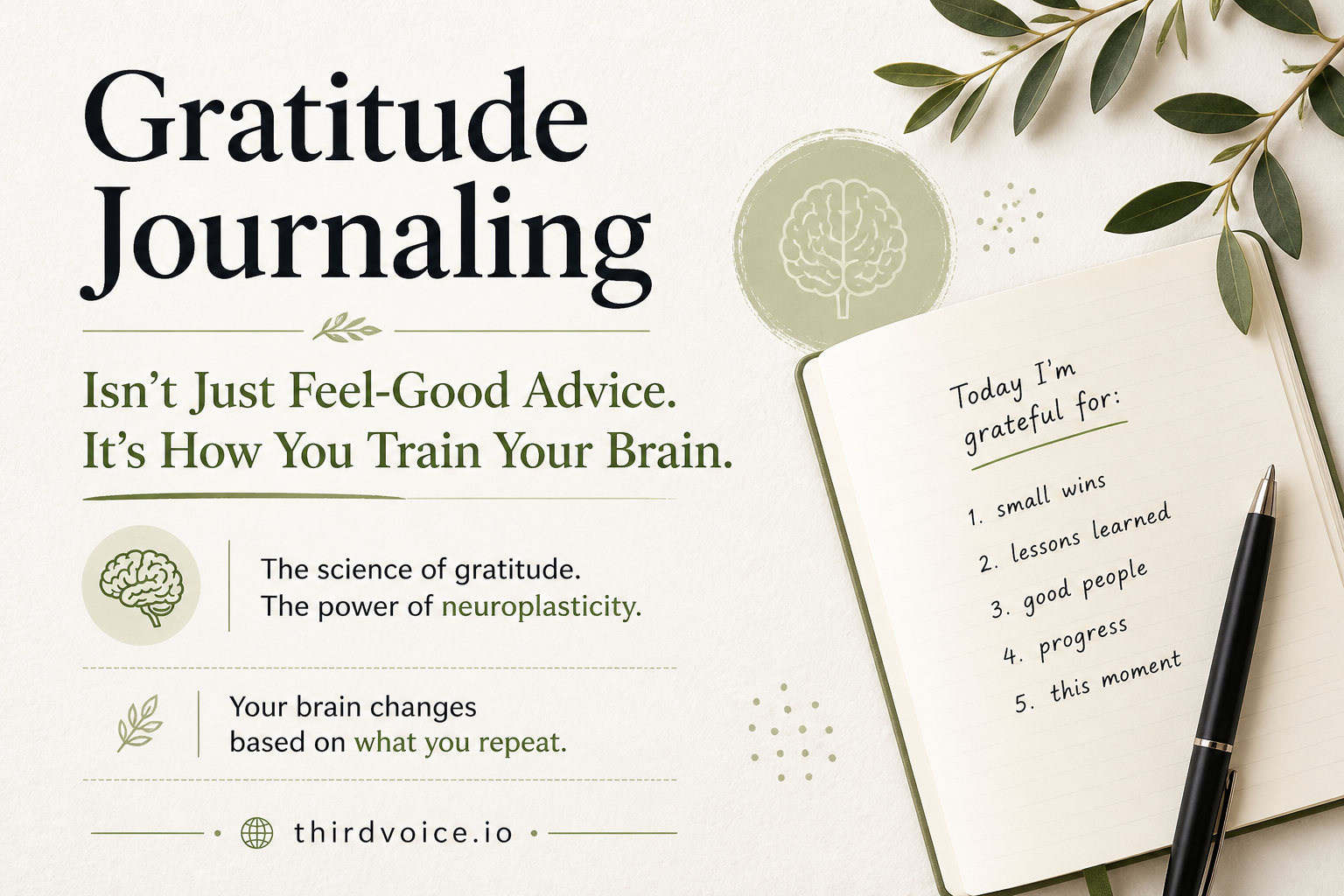
Gratitude journaling feels simple. But what it's doing is not. It's gradually shifting what your brain prioritizes. And over time, that changes how you think, feel, and respond.
Gratitude journaling is often treated like soft advice. Write down a few positive things. Feel slightly better. Move on.
But that framing misses what is actually happening. A daily gratitude practice works because it changes what your brain repeatedly notices, stores, and strengthens.
Gratitude journaling helps because it changes what your brain keeps practicing.
Your brain is wired to notice what is wrong
The human brain has a built-in negativity bias. It pays extra attention to threats, mistakes, and uncertainty, not because you are broken or pessimistic, but because that bias helped humans survive.
The downside is obvious in everyday life. You can make progress, handle something well, or feel slightly better than you did last month, and your brain may still spotlight the awkward conversation, the unfinished task, or the thing that might go wrong next.
What you repeatedly notice gets reinforced
This is the basic logic of neuroplasticity: the brain strengthens the pathways it uses most often.
If your attention keeps returning to stress, self-doubt, and problems, those pathways become more familiar. Over time they start to feel automatic, not because they are true, but because they are practiced.
Negativity bias
Your brain scans for threats, mistakes, and uncertainty first.
Repetition matters
What you revisit often becomes easier to access again.
Neuroplasticity
Attention patterns gradually shape your mental baseline.
Gratitude journaling changes the input
This is why gratitude journaling benefits go deeper than mood. The practice interrupts a default pattern and asks your brain to do something it does not naturally prioritize: look for what is working.
When you write down something that went well, something you handled better, or something you appreciate, you are deliberately feeding your attention a different category of data.
That matters. Attention is not neutral. What you keep returning to becomes easier to find again tomorrow.
This is not toxic positivity
Gratitude journaling is not about pretending everything is fine. It is not denial. It is not bypassing real pain.
It is a correction. Your brain already overweights the negative. A gratitude journal helps reintroduce signals that would otherwise be filtered out or forgotten too quickly to matter.
The key distinction
Gratitude does not ask you to ignore what hurts. It asks you not to let negativity be the only evidence your brain records.
Repetition is what creates change
Doing this once will not transform much. But repeated daily, the pattern begins to shift.
Your brain starts noticing positive signals faster. It holds onto them a little longer. It begins to factor them into how you interpret the day instead of discarding them immediately.
That is what how gratitude changes your brain really means in practice: small inputs, repeated consistently, slowly creating a different baseline.
A simple gratitude journaling practice
You do not need elaborate gratitude journal prompts. At the end of the day, write:
- 1 thing that went well
- 1 thing you handled better than before
- 1 thing you are grateful for
That is enough. The goal is not intensity. The goal is repetition.
You are not just reflecting. You are training.
Gratitude journaling for mental health works because it is a practice of directed attention. You are not simply documenting your day. You are training your mind to register more than danger, stress, and lack.
Over time, that can change how you think, how you feel, and how quickly you recover from difficult moments.
A simple practice that gets stronger with memory
Use ThirdVoice to keep a reflection habit going and notice the emotional patterns a notebook might miss.
Final thought
You do not change your brain by thinking differently once. You change it by repeatedly directing your attention in a different way.
Daily gratitude practice is one of the simplest ways to do that. Train what your mind repeats.
Common questions
Does gratitude journaling actually help?
Yes, mainly because it repeatedly redirects attention toward positive signals your brain might otherwise skip. The effect is usually gradual, not dramatic, but repetition matters.
How long does it take for gratitude journaling to work?
It usually works through consistency rather than intensity. A few short daily entries tend to matter more than rare, deep journaling sessions.
What should I write in a gratitude journal?
Keep it simple: one thing that went well, one thing you handled better than before, and one thing you are grateful for. The structure is basic on purpose so you can repeat it.
Is gratitude journaling the same as positive thinking?
No. Positive thinking can slip into denial. Gratitude journaling works better as a correction to negativity bias, not as a way to pretend difficult things are not real.